
The Painting from Rome: Why Some Souvenirs Become Sacred

Most souvenirs are bought to prove we went somewhere.
The best ones remind us who we were when we were there.
In Rome, near the Colosseum, street artists often line the walkways with paintings, sketches, and small canvases of the ancient arena. Some are quick impressions for tourists. Others feel like they are carrying something more — a little bit of the city’s soul pressed into color and shadow.
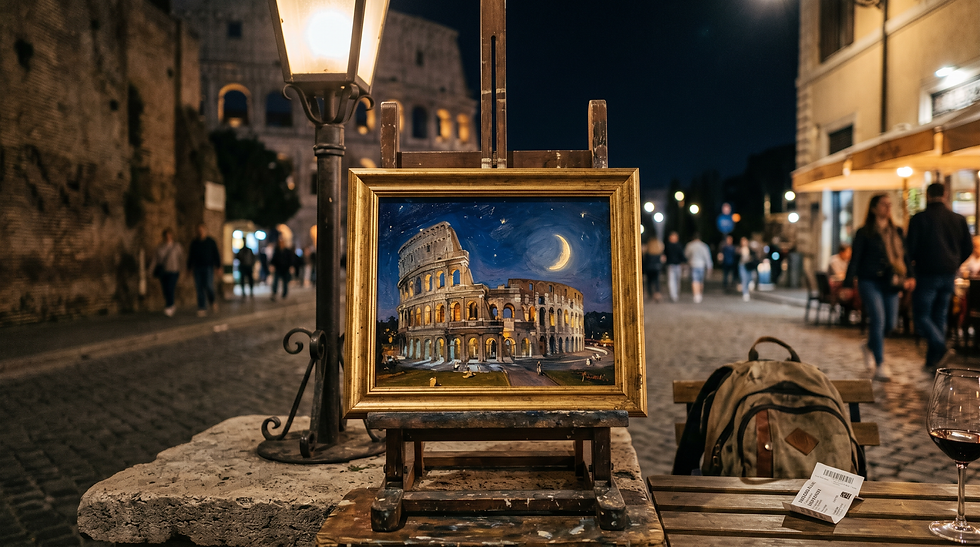
In Penny and Rome, one painting becomes more than a keepsake.
It becomes a witness.
That night, after circling the Colosseum beneath the rising moon, there was a moment of recognition. A street artist stood under a dim lamp, working quietly as the city moved around him. On his canvas, the Colosseum began to appear. Then came the moon.
And when the moon was added, the painting was no longer just an image.
It was the night.
The walk. The wonder. The ache. The hope. The fragile beauty of two people standing in a place older than almost anything they had ever known, trying to hold onto something they could not fully name.
That is what meaningful souvenirs do.
They gather the invisible.
A receipt cannot do that. A magnet rarely can. A keychain might help you remember a city, but certain objects help you remember the person you were in a moment you never wanted to lose.
The painting from that night mattered because it did not feel staged. It was not hunted down in a polished shop or selected from a perfect display. It was found in the flow of the evening, after the Colosseum had already done its work on the heart.
Sometimes the object chooses the memory as much as we choose the object.
There is a beautiful tension in that chapter of Penny and Rome. Earlier in the evening, Penny wonders about taking a small piece of broken stone from near the Colosseum — a physical fragment of Rome to carry home. It is playful, almost childlike, but also deeply human.
We want proof that beauty happened.
We want something we can touch when memory starts to feel too far away.
But the truth is, the most important pieces of a place cannot be taken. Not legally, thankfully. Not fully, anyway.
You cannot take the air around the Colosseum at dusk.
You cannot take the sound of a voice whispering in awe.
You cannot take the moonlight as it falls across ancient stone.
You cannot take the exact feeling of hope rising in your chest after a long season of pain.
But you can take a painting.
And sometimes that is enough.
Not because the painting contains the whole memory, but because it opens the door back to it.
This is one of the reasons travel plays such an important role in Penny and Rome. The cities are not just locations. They become containers for emotional truth. Paris, Lisbon, Milan, Rome — each place holds something. Each place reflects something. Each place becomes part of a story that is really about love, loss, reconciliation, faith, and the mystery of restoration.
The painting still matters because memory still matters.
It hangs on a wall, but also somewhere deeper. It holds the shape of a night when Rome felt alive, when the moon seemed to follow, when hope felt almost tangible.
Not every souvenir is sacred.
But some are.
Some carry a chapter.
Penny and Rome is a forthcoming book series about love, travel, loss, faith, and restoration. Join the journey for behind-the-story posts and pre-order updates.
Comments